The Schurz library has chosen to highlight chemistry this year for the month of October - so no, that's not a Halloween ghost in the right side of the display cabinet, but rather a chemistry lab coat. But just like Halloween, chemistry is "out of this world", which is the theme this year set by the American Chemical Society for National Chemistry Week of October 21-27. Keep a lookout for a future post in which students from the Biology-Chemistry Club hold an outreach event at the local public library for kids. Thanks to Assistant Dean (and inorganic chemist) Bill Feighery and Vice Chancellor (and organic chemist) Doug McMillen for setting up the library display.
Friday, October 12, 2018
Sunday, September 16, 2018
Biology-Chemistry Club starts off strong
We aren't even a month into the Fall semester, and yet the Biology-Chemistry Club is full of action. The events actually started toward the end of summer session II when the club organized a community outreach program at the Riverpark Library called Rock Candy Romp! The event was held on July 31, and while it lasted just one hour, it was a very intense time of science fun. Our students prepared a volcano and set up some dissecting microscopes for kids to look through. Club members also helped kids make rock candy - an early introduction to recrystallization to prepare them for organic chemistry lab (in the far future).
Next there was the Fall Semester Kickoff at the end of the first week of classes held at Lang Lab in the evening. Professors and students got a chance to mingle and relax before the onslaught of test-taking (for students) and grading (for faculty). Thanks to the club for generously providing the pizza. The collage above is a collection of photos taken that night.
The club also sponsored "Research Night" on September 10th during which students got a chance to hear about the research that faculty are conducting on campus. Students can get involved in such activities for course credit (such as CHEM-C 409 Chemical Research) or even for pay (as a work-study student during the Fall and Spring semesters or funded by a SMART or LSAMP grant during the Summer.
The next plan that is in the works is another science outreach event, this time planned for the children at the Ronald McDonald House Charities at Memorial Hospital. If you are interested in helping with this activity or wish to join the Biology-Chemistry Club, please contact any one of the biology or chemistry faculty and they'll put you contact with someone from the club.
Monday, September 3, 2018
Students return from summer research
While many of our students worked on campus this summer researching the faculty here, three of our biochemistry majors researched elsewhere. One of these was Sandy Ho who won our campus's RC Med Review Research Fellowship last spring. She worked with Professor Laurie Littlepage at the Mike and Josie Harper Cancer Research Institute which is a collaboration between the IU School of Medicine and the University of Notre Dame. Ho studied how oxidative stress affects breast cancer cells in the presences or absence of a specific aquaporin (a channel protein that allows water and glycerol to flow across the cell membrane).
Hunter Richman attended the University of Delaware REU program sponsored by the National Science Foundation. He researched the kinetics and thermodynamics of post synthetic ligand exchange in Cu(II) metal organic cages with graduate student Garrett Taggart in the group of Professor Eric Bloch. Richman enjoyed the hands-on research experience and the preview into what graduate school might be like. He stands by his research poster (on the right) beside his professor in the photo below during a symposium at the end of the summer. You can find their abstract HERE.
Maggie Fink who was funded by the National Science Foundation REU program to work at the University of Notre Dame in Dr. Shaun Lee's biology lab. Fink describes her work and experience in the paragraph that follows. She is pictured second from the right in the photo above.
"I worked with Streptococcus pyogenes, the human pathogen responsible for strep throat and necrotizing fascitis. Specifically, I investigated the role of streptococcal pyrogenic exotoxin B (SpeB) in virulence through interactions with Streptolysin S. SpeB is a protease with a large number of known substrates and no definite link to its activity correlates to the severity of infection. Streptolysin S is toxin responsible for red blood cell lysis and serious infections. Understanding the interactions between the two, if any even exist, could provide insight into how S. pyrogenes can cause a range of infection severity in hosts, from remaining commensal to a life threatening illness. Participating in the REU program at Notre Dame challenged me as a scientist to think creativity and critically when deisgning experiments and analysing data. Additionally, working with graduate students in a larger lab gave me a better idea of what going to graduate school will be like and helped solidify my desire to pursue a PhD and career in research."
Summer research, whether on- or off-campus, has a wide range of benefits. It is often a paid position so you can earn money gaining experience rather than waiting tables, and it can help you decide whether research is really what you want to do. It used to be that undergraduate research helped you stand out from the crowd when applying to graduate school; nowadays, it is becoming the norm, so that you may be at a disadvantage if you lack research experience.
Monday, August 27, 2018
Faculty attend education conference at summer's end
The 25th Biennial Conference on Chemical Education was held at the University of Notre Dame this summer. Department chair Gretchen Anderson, associate professor Grace Muna, assistant professor Shahir Rizk, laboratory supervisor Connie Fox, and adjunct professor Merilee Britt eagerly took advantage of the close locale. The conference started on Sunday, July 29 and ended on Thursday, August 2.
During the conference Dr. Marya Lieberman of Notre Dame, who gave one of the plenary lectures, invited instructors teaching undergraduate analytical chemistry courses to participate in a project to analyze pharmaceutical drugs distributed in developing nations to test their quality. Muna's analytical chemistry class (CHEM-C 310) will analyze levofloxacin using HPLC this semester as part of the project to give her students a chance to do real life application of analytical chemistry.
Rizk (pictured below) gave a presentation titled "Transitioning students from the classroom to the world; creating better prepared and more engaged scientists" based on current, and planned, efforts many in our senior-level biochemistry courses (CHEM-C 484, 485, 486). While success in the classroom for four years is great, it is success for the rest of one's life in the real world that truly matters. Whether students graduate from IU South Bend to pursue graduate school, medical school, industry, or some other endeavor, we hope that we are giving them the tools to succeed.
Saturday, July 7, 2018
Summer research with Muna
Professor Grace Muna is the analytical chemist of the department. She shares with Professor Rizk the uncanny ability to keep her lab occupied year-round with undergraduate research students, which is a very difficult task because coursework typically pulls students away during the fall and spring semesters. This summer she has three students working with her on projects combining electrochemistry and nanochemistry.
Another biology major, Joel Green, (pictured left) came on board just three weeks ago. He stopped by to chat with Stacey and he took so long that Dr. Muna thought she should put him to work. She asked him whether he would be interested in research and he was up to it. Joel is working on the same project with Stacey, however, he's modifying gold (not glassy carbon) electrodes with gold nanoparticles and testing their performance on the catalytic oxidation of homocysteine and cysteine. This allows the group to do a comparison study to see which modified electrode outperforms the other in terms of selectivity, sensitivity and stability.
Chemistry major Joseph Williamson (pictured right) was continuing the ongoing work of developing a portable method to detect lead in water. He was testing whether bismuth nanoparticles on glassy carbon electrodes can be stabilized by a nafion polymer (based on Teflon) to enhance their long term stability. Joseph recently moved back to his home state, and will be continuing his education at University of Arkansas in the fall.
Thursday, June 28, 2018
Summer research with Rizk
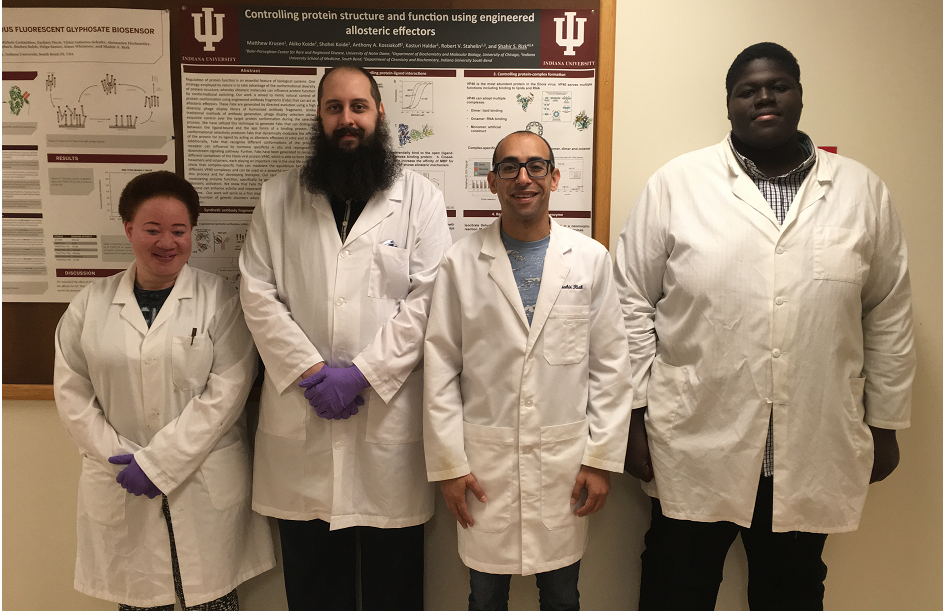
The biochemistry lab of Professor Shahir Rizk (pictured second from the right) is rarely quiet during the academic year – and it is even busier this summer with three undergraduate research students. Biology major Pierre-Emmanuel N'Guetta (pictured far right) is continuing work on a project to develop a biosensor for glyphosate, the main ingredient in the herbicide RoundUp. He began the project last year with the help of a SMART grant, and now he has a protein-based fluorescent biosensor that can detect micromolar amounts of the pollutant. He is currently trying to use this biosensor to test for glyphosate in soil samples.
Biochemistry major Winnie Ihano (pictured far left) is funded by the LSAMP program. Her goal is to express and purify mutants of the human enzyme adenosine deaminase. This enzyme is important in the degradation of the nucleotide adenosine. Individuals with mutations in this enzyme suffer from Severe Combined Immune Deficiency (SCID), a fatal disease that leaves its victims susceptible to all kinds of infections. Winnie is generating recombinant forms of these mutants found in SCID patients and trying to isolate them in order to characterize them in the lab.
Biology major Chris Stewart (pictured second from the left) is also working on adenosine deaminase. His work, funded by a SMART grant, is concerned with engineering antibody fragments that can bind to the active form of the enzyme. By recognizing the active form of the enzyme, we hope that these antibody fragments can be used to convert the less active mutants found in SCID patients into active enzymes with the hopes of reversing the effect of the disease (at least in the test-tube).
In addition to his research with these three students, Rizk has been busy with other projects. He attended the first Regional Cottrell Scholar meeting in April at the University of Illinois, Urbana-Champagne, at the invitation of St. Mary’s chemist Dr. Kathryn Haas, a recent Cottrell Scholar who had previously taught at IU South Bend for a year before teaching at St. Mary’s College. The Cottrell foundation supports chemistry, physics, and astronomy professors who are developing innovative research and teaching programs at their institutions through their Cottrell Scholars Program. The meeting included former Cottrell scholars and members of their research groups as well as hopeful future Cottrell Scholars (such as Rizk).The meeting included presentations and roundtable discussions on research and teaching methods. Rizk had the chance to present a poster on his research in protein engineering and his teaching strategies that use discussion sections to introduce STEM majors to current events in science policy and new research developments through assigned readings and guest lectures by practicing scientists from academia and industry. Rizk was invited to submit a full application for the Cottrell Scholar program in July and we wish him success in this endeavor.
Saturday, June 9, 2018
Summer research with Marmorino
No goggles for these students. Chemistry majors Conor McGee and Christian Moreno are spending the summer working on quantum mechanical problems with Professor Matt Marmorino. Their work is a combination of theory and computation - not a single chemical will be harmed in their research. Instead they'll be making good use of Mathematica to run number-crunching programs that they are very busy writing.
McGee is funded by the Carolyn & Lawrence Garber Summer Research Scholarship which is awarded each summer to just one chemistry or biochemistry major. He is testing (on the hydrogen atom) some old, but underutilized, techniques to calculate bounds to the energy and position moments for atoms and molecules. These techniques require information that is typically not available for traditional trial wave functions, but Conor is introducing an adjustable defect into the wave functions that, while reducing the quality of the wave function, allows for atypical information about the system to be calculated and utilized. If the approach works well on the hydrogen atom, then it should also work on more complex atoms and molecules too.
Moreno's work is supported by one of several Louis Stokes Alliances for Minority Participation (LSAMP) grants provided to STEM students at IU South Bend. He is testing simple quantum mechanical models to duplicate the known trends (such as atomic radius, ionization energy, and ground-state electron configuration) in the periodic table. The hydrogenic model, which ignores electron-electron repulsion is too simple to reproduce the trends; but the commonly-used Hartree-Fock method, which incorporates repulsion, is too complex for the beginning science student to fully appreciate and lacks a [rigorous] simple orbital interpretation. Moreno is testing a model based on first-order perturbation theory that partly mimics the hydrogen model in simplicity, but incorporates at least some of the repulsion to reproduce the periodic trends. He's hoping that he doesn't need to deal with the repulsion in its full glory, because that is quite a task.
Subscribe to:
Posts (Atom)